
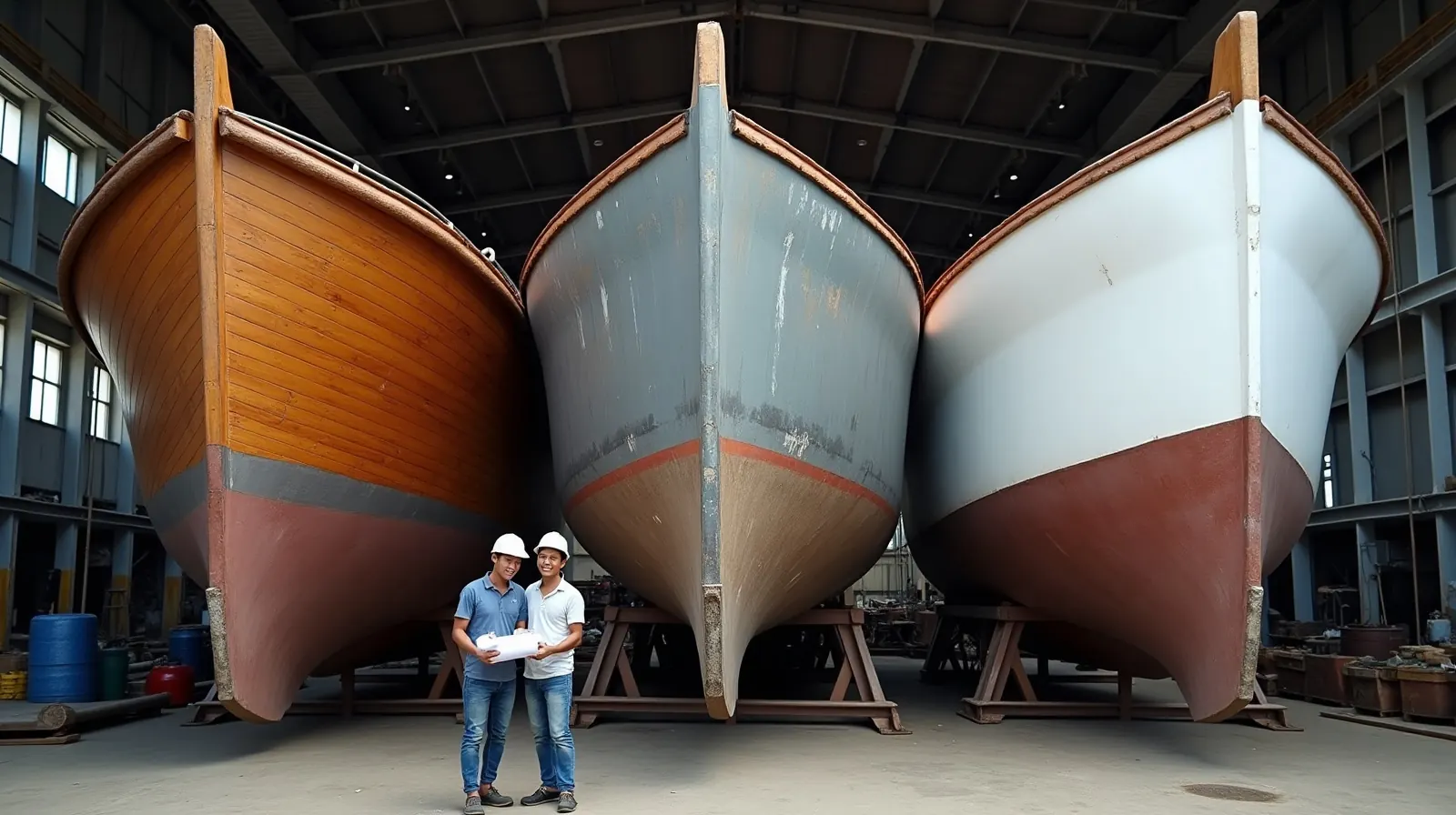
In short: Build price is only the opening bid. Over ten years of Indonesian ownership, a wooden hull trades a lower entry cost for steady annual timber and caulking work; steel trades a higher entry cost for paint-cycle economics and docking discipline; FRP costs the most per metre up front from a good yard but runs the flattest maintenance curve. The right answer depends on usage, route and how honestly you will maintain the boat — not on the sticker price.
“Which is more economical — wood, steel or fibreglass?” is the question we hear most from first-time commissioning clients, and the honest answer needs a time axis. A comparison frozen at handover day misleads; a comparison across ten years of real Indonesian operation informs. Drawing on build records and refit invoices across our network, here is how the three material families actually behave over a decade. For the structural fundamentals behind each, start with our material-by-material comparison of wooden, fibreglass and steel construction.
Year zero: what you pay at the yard
Per metre of comparable displacement vessel in today’s Indonesian market, traditional hardwood construction — the craft economy described on our wooden boat construction page — carries the lowest entry cost, helped by ulin and bitti timber and yard labour rates in the builder communities of Sulawesi, including the yards on our Bulukumba network page. Steel comes in higher once plate, welding consumables and blasting are counted, and demands the industrial infrastructure covered in our steel construction guide. Quality FRP from a controlled mould shop is typically the highest per metre for one-off hulls, because tooling must be built or amortised — the economics shift only in serial production, as our production line article explains. Current per-metre bands for all three sit in our construction cost guide.
Years one to five: the curves separate
Wood asks for attention early and often: annual recaulking of working seams, recoating, zinc renewal, and vigilance on freshwater ingress around deck fittings. Budget roughly 3 to 5 percent of build cost per year in tropical service, more if the vessel works hard. None of it is exotic — every coastal town has shipwrights — which is wood’s quiet advantage: repairs are local, fast and priced in rupiah, billed to you in USD equivalents that stay modest.
Steel spends little in years one to three if the original blasting and coating were done to specification, then presents its first serious invoice at the five-year docking: full inspection, anode renewal, breakdown repair of coating damage, and treatment of any dissimilar-metal trouble spots. Coating quality at build is destiny; a hull painted over poor surface preparation reaches this docking with rust bloom that costs multiples to chase.
FRP runs flattest: antifouling cycles, anodes and gelcoat care. The risks are discrete rather than continuous — osmosis on poorly built laminates, impact damage, UV fatigue on unprotected surfaces. A moisture survey at year five, part of any competent marine survey, catches the one problem that gets expensive if ignored.
Years five to ten: where budgets are won and lost
By the second half of the decade, wooden vessels face their first plank-and-fastening renewals in high-stress zones — manageable when scheduled, painful when deferred into emergency haul-outs. Steel meets its ten-year special survey with plate thickness gauging; well-coated hulls sail through, neglected ones meet the needle gun and the chequebook. FRP, if the laminate was honest, mostly needs cosmetics and systems renewal. Across the fleet we track, ten-year cumulative maintenance as a share of original build cost lands roughly at 30 to 45 percent for hardworking wood, 20 to 35 percent for steel, and 12 to 22 percent for FRP — bands, not promises, and utterly dependent on maintenance honesty. Insurance premiums follow the same logic, as our article on construction and hull insurance sets out.
Choosing on the whole curve, not the entry point
Match material to mission. A charter phinisi trading on character and repairable anywhere in the archipelago argues for wood. A vehicle ferry or expedition hull that takes ground contact argues for steel. An owner who wants predictable costs and minimal yard time argues for FRP. Demand for each is shifting too — our review of 2027 order books shows where Indonesian yards see the next decade going. Whatever you choose, contract the maintenance-critical items (coating specifications, timber grading, laminate schedules) explicitly at build stage; every rupiah of corner cut there returns as ten in year seven.
Run your own numbers with us
We prepare ten-year cost-of-ownership models for clients comparing materials before contract — real Indonesian yard rates, real docking schedules, in USD. Request a free consultation, message us on WhatsApp at +62 811 3941 4563, or email [email protected] with your intended use and size range, and we will model the whole curve before you commit to the entry point.
Frequently Asked Questions
Which hull material has the lowest ten-year total cost?
For moderate private use, FRP usually wins on total cost despite the higher entry price, because its maintenance curve is flattest. For heavy commercial use with local repair needs, wood’s low entry cost and repair-anywhere economics keep it competitive. Steel wins where the mission demands it and coating quality is enforced at build.
What single decision most changes lifetime cost?
Surface protection at build: timber seasoning and fastening quality on wood, blasting and coating specification on steel, laminate and gelcoat control on FRP. Each is contractible and inspectable during construction — and nearly impossible to retrofit economically afterwards.
Are these curves different outside Indonesia?
The shapes hold; the absolute numbers shift. Indonesian labour rates make wood’s annual attention affordable here in a way it is not in Europe or Australia, which is one reason wooden commercial fleets remain economically rational across the archipelago.
Can I switch maintenance strategies mid-life?
Partially. A steel hull can be re-blasted and recoated to reset its curve, and a wooden hull can be systematically refastened — both are major refit events better planned than forced. An FRP hull with laminate problems is the hardest to reset economically, which is why the pre-purchase moisture survey matters so much.

Written by
