In short: Never take over an unfinished boat build on the seller’s word alone. A half-done hull hides its problems inside laminates, scarf joints and undocumented payments. Before any money moves, commission an independent audit covering structure, materials, class status, yard debts and legal title — then price the takeover on what the audit finds, not on what the previous owner spent.
Every year, owners approach us with the same situation: a build that stalled at thirty, fifty or seventy percent, a yard that has gone quiet, and an asking price based on “money already invested”. Our build completion and takeover service exists because these projects can be excellent value — but only when the audit comes first. This article walks through exactly how we audit a half-done hull in Indonesia, what the inspection covers, and the red flags that change a takeover price by six figures in USD.
Why “money already spent” is the wrong starting number
A stalled project is not worth what has been paid into it. It is worth the cost of a finished, certified vessel minus the realistic cost to complete — including remediation of every defect the first phase left behind. Those two numbers are often far apart. We have audited hulls where USD 400,000 of recorded spending produced perhaps USD 220,000 of recoverable structure, because timber was bought at inflated prices through intermediaries, framing was done to no drawing, and the deck layout had to be reversed for the intended charter use.
The audit exists to establish the only figure that matters: cost-to-complete. Once you hold a defensible cost-to-complete, the negotiation with the seller becomes arithmetic instead of argument.
The structural survey: what we open up and why
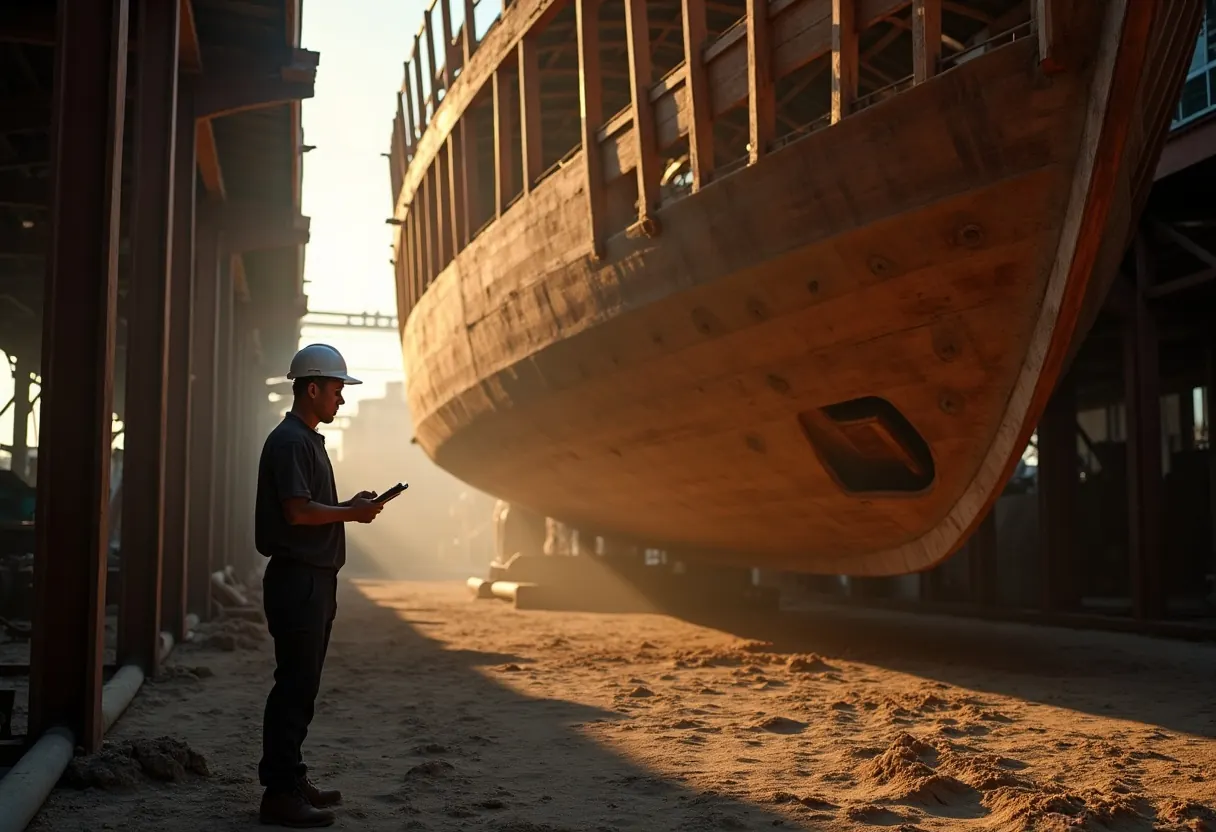
A half-done hull is, in one sense, the easiest vessel you will ever survey — nothing is hidden behind joinery yet. Our surveyors, working to the same discipline described on our marine survey and inspection page, focus on five zones:
Keel and backbone. On wooden vessels we verify the keel timber species (ulin is the benchmark for Sulawesi builds), check scarf joints for fit and fastening, and probe for early rot where rainwater has pooled during the idle period. A hull that has sat uncovered through two wet seasons needs particular attention here.
Frames and floors. We measure frame spacing against the design drawings — if drawings exist at all — and map every frame that is undersized, split or badly grained. On steel projects the equivalent check is weld quality and plate thickness verification, as covered in our steel construction guide.
Planking and laminates. Fastener quality is the classic hidden defect: galvanised fasteners where bronze or stainless was specified will halve the working life of the hull. On fibreglass hulls we take moisture readings and inspect laminate schedules against what was invoiced.
Fairness and geometry. We string-line and laser-check the hull for symmetry. A hull built without proper lofting can be visibly banana-shaped only when measured — and correcting geometry late is one of the most expensive operations in boatbuilding.
Protection during the idle period. How the hull was stored tells you how it was built. Proper stanchions, tarpaulins and ventilation suggest a yard that cared; a hull propped on loose blocks in standing water suggests the opposite.
The paper audit: debts, title and class status
Half of takeover risk is not in the timber at all. Before completion work can start, three paper questions need clean answers.
First, who owns the hull? In many stalled Indonesian projects the build contract is informal, payments went to personal accounts, and the yard, the broker and the owner each believe they hold rights. We require a signed transfer of title and a written release from the yard before we mobilise. Our page on registration and export procedures explains the documentation a finished vessel will eventually need — and it all starts from clean title now.
Second, what does the yard claim it is owed? Unpaid yard balances follow the hull in practice, whatever the contract says, because the hull sits on the yard’s land. We negotiate and document settlement as part of takeover.
Third, where does classification stand? If the hull was started under BKI or another class society, missed surveys may mean repeating inspections or, in the worst case, losing class approval for work already closed up. Our BKI classification guide covers why survey continuity matters; an unclassed restart is possible but adds cost and time.
From audit to takeover price
The audit report we deliver has three sections: a defect and remediation schedule with line-item USD costs, a cost-to-complete estimate built on our current Indonesian construction cost benchmarks, and a recommended maximum takeover price. Owners use the report in negotiation; several have walked away entirely, which is also a good outcome — the audit fee is small insurance against a seven-figure mistake.
Where the numbers work, we move the project into a supervised completion phase with the stage gates and hold points we apply to every build in our network, from Bulukumba phinisi yards to steel and fibreglass facilities across the archipelago. The finished vessel gets sea trials, survey and a full handover file, exactly as a new build would.
Get a takeover audit before you commit
If you are considering an unfinished hull anywhere in Indonesia, talk to us before you transfer anything. Request a free project assessment, message us on WhatsApp at +62 811 3941 4563, or email [email protected] with the project location and any photos you have. We will tell you honestly whether the project deserves an audit — and what it will take to finish it properly.
Frequently Asked Questions
How much does an audit of an unfinished boat build cost?
Most single-hull audits in Indonesia run between USD 2,500 and USD 8,000 depending on vessel size, location and whether legal due diligence is included. On a takeover decision worth hundreds of thousands of dollars, it is the highest-leverage money in the entire project.
Can a stalled wooden hull that sat uncovered still be saved?
Often, yes. Dense timbers like ulin and bitti tolerate exposure far better than softwoods, but we open up suspect zones, replace any compromised members and document everything. The audit determines whether remediation is economic — sometimes a partial rebuild of the affected structure costs less than the price reduction you could negotiate for it.
What is the single biggest red flag in a takeover project?
Unclear title. Structural defects can be measured and priced; a hull with disputed ownership or undocumented payments can trap your capital indefinitely. We do not begin completion work until title transfer and a yard release are signed.
Do you audit projects outside your own yard network?
Yes. We audit stalled builds at any Indonesian yard, and owners then choose whether to complete in place under our supervision or relocate the hull to a yard in our network for the finishing phase.

Written by
