
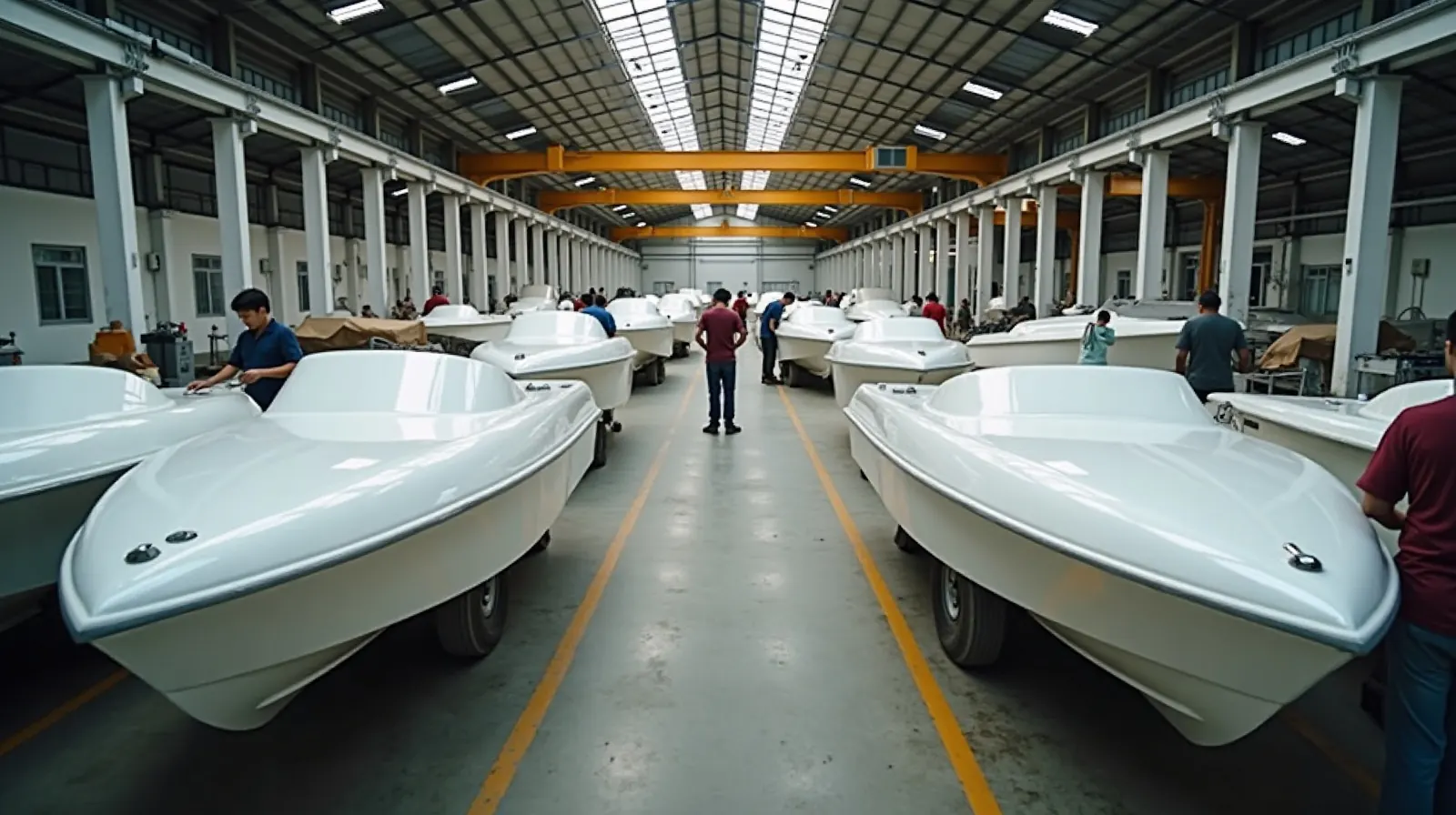
In short: Serial speedboat production is a different craft from one-off boatbuilding. A well-run Indonesian line builds each hull from controlled moulds, laminates to a written schedule with weighed resin batches, fits out on jigs, and tests every boat to the same documented standard. The result is repeatability: hull number twenty behaves like hull number three. Buyers should judge a production yard by its process discipline, not its showroom.
Most of what we publish concerns custom builds — a single vessel, one owner, one contract. Serial production answers a different question: how do you build the same boat forty times and have every one come out right? Indonesia’s FRP speedboat lines, clustered around Batam, Tangerang and Surabaya, supply resort transfers, dive operations, patrol fleets and private buyers across the region. Walking a good line teaches lessons that benefit every boat buyer. Here is what happens inside one, station by station.
Station one: the mould shop is the product
Everything in serial FRP building descends from the plug and the moulds. A production mould is a capital asset — faired to a tolerance a one-off builder would never pay for, waxed and inspected between every pull, and retired when print-through or dimensional drift appears. Ask a yard how many pulls their hull mould has taken and how they track it; the answer tells you more than any brochure. The material science behind laminate choices is covered in our fibreglass construction guide, and how FRP compares over a decade of ownership in our ten-year cost curve analysis.
Station two: lamination under batch control
On a disciplined line, lamination is chemistry with paperwork. Resin and catalyst are weighed per batch and logged against ambient temperature and humidity; glass schedules specify each layer by weight and orientation; and coupon samples from production laminates are periodically burn-tested to verify glass content. Vacuum infusion, increasingly common on better Indonesian lines, adds consistency a hand lay-up cannot match. Every laminate record feeds the hull’s build file — the same documentation habit we urge on custom builds in our article on digital build diaries.
Station three: fit-out on jigs, not by eye
Serial fit-out runs on jigs and kitted parts: stringers and bulkheads bonded in fixtures, consoles pre-wired on the bench, fuel systems assembled and pressure-tested as modules before installation. Engine rigging follows the maker’s serial templates. This is where production boats quietly beat many one-offs — a loom built on a bench jig by the same technician every week is simply more reliable than one improvised in a hull. Deviations still happen; the yards worth your money run a hold-point system between stations, a lighter version of the QA hold points we mandate on custom projects.
Station four: every hull gets tested — not just the first
The tell of a serious line is what happens after fit-out. Each completed boat is tank-tested for fuel and water integrity, run on the water through a standard acceptance protocol — WOT rpm within the engine maker’s band, trim behaviour, hard-over turns, electronics calibration — and signed off against a checklist that travels with the hull. Type approval on the first boat never substitutes for testing the fortieth. When a hull does underperform, the diagnostic path is the one we map in our article on sea trial failures. Production discipline also matters at fleet scale: ferry operators buying serial fast boats, as covered in our review of Indonesia’s passenger boat sector, live and die by hull-to-hull consistency.
What buyers should ask a production yard
Six questions separate the professional lines from the assemblers: How many hulls from the current mould, and how is mould condition tracked? Can I see the laminate schedule and a batch log? Are fuel systems pressure-tested per hull? What is the per-boat water test protocol? What warranty follows the boat, and who honours it outside Indonesia? And can I visit unannounced? A yard confident in its process will welcome the visit. We audit production yards for fleet buyers as part of our speedboat building service, applying the same supervision framework described on our process page — and where a buyer inherits a stalled or defective series, our completion and takeover team puts the programme back on rails.
Buying serial boats? Bring us in early
Whether you need one resort tender or a fleet of twenty patrol boats, an early yard audit costs little and prevents the expensive kind of surprise. Request a free consultation, message us on WhatsApp at +62 811 3941 4563, or email [email protected] with your requirement and quantity, and we will shortlist lines whose process discipline matches the job.
Frequently Asked Questions
How much does a production speedboat cost in Indonesia?
Resort and dive-class FRP boats of 8 to 12 metres typically run USD 45,000 to USD 180,000 depending on engines, layout and electronics; 15-metre-plus fast crew boats and patrol hulls range from USD 250,000 upward. Serial pricing per hull falls meaningfully on multi-boat orders because moulds and jigs amortise.
Is a production boat lower quality than a custom build?
Not inherently — the opposite is often true for systems reliability, because jig-built modules and repeated processes reduce human variation. Quality tracks the yard’s process discipline: batch-controlled lamination and per-hull testing beat artisan improvisation for identical boats.
How fast can a production line deliver?
An established line with free mould capacity delivers a configured boat in three to six months; fleet orders run on a drumbeat of one to four hulls per month once tooling is flowing. Custom deviations from the standard layout are what stretch schedules, so decide options early.
Can production hulls be exported?
Yes — Indonesian FRP boats ship worldwide by flat-rack or on their own bottoms regionally. Export paperwork, engine emissions conformity for the destination market and flag registration are handled at order stage; build in four to eight weeks for documentation and shipping on top of production time.

Written by
