
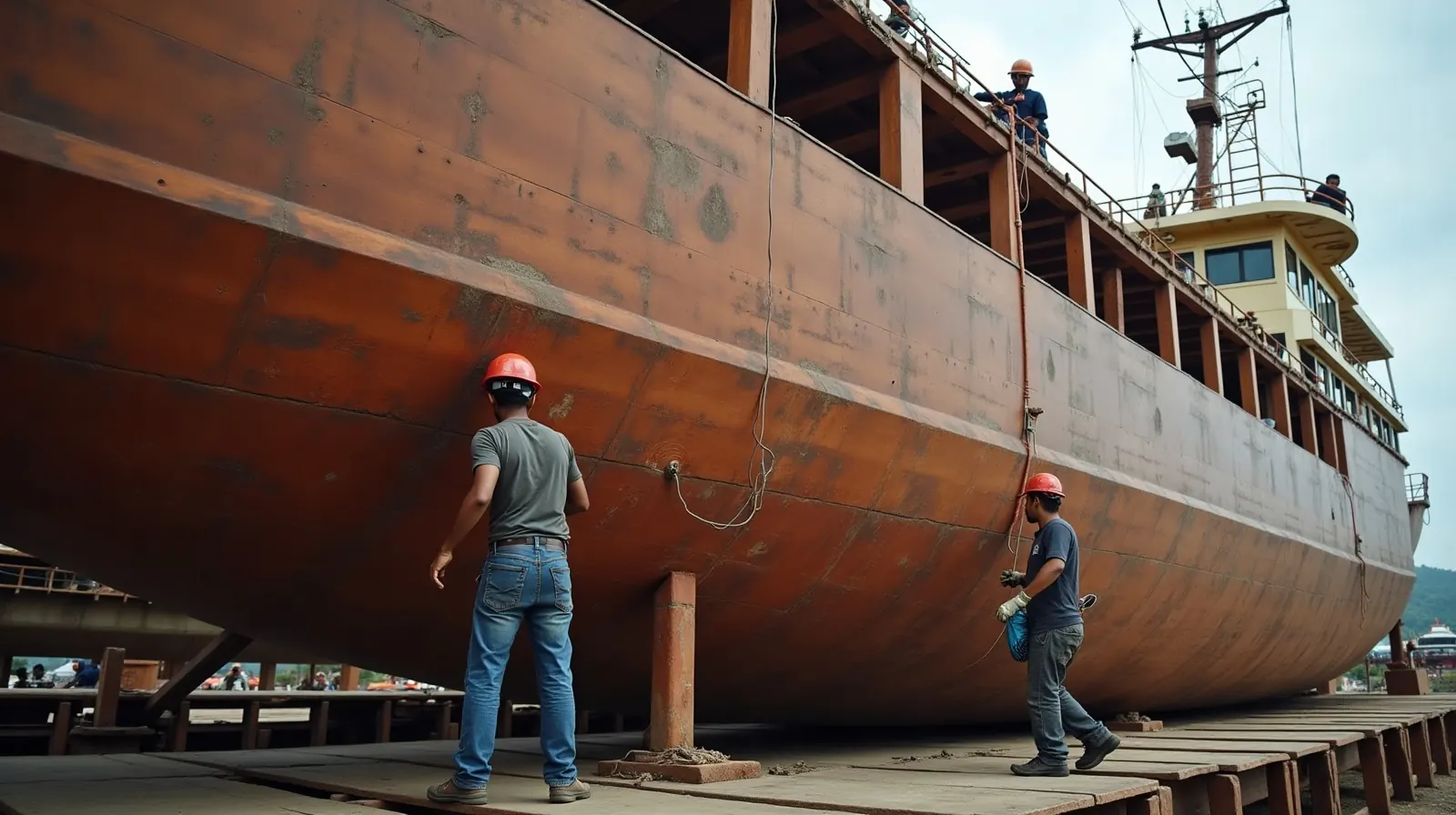
In short: No Indonesian yard builds your boat alone. Behind the contract you sign sits a web of subcontractors — timber suppliers, welding crews, electricians, joiners, painters, engine agents, riggers — and the quality of your vessel is decided as much by how that web is managed as by the yard’s own hands. Smart owners map the web, contract for visibility into it, and verify the critical nodes.
Owners tend to imagine “the yard” as a single workshop where everything happens. The reality on almost every Indonesian build over 20 metres is a network: a core yard workforce surrounded by specialist crews who arrive, do their trade and move to the next project. This is not a weakness — it is how boatbuilding works worldwide — but an unmapped network is where quality, schedule and money quietly leak. Here is who actually works on your boat, and how to manage the web instead of being surprised by it.
The core yard versus the travelling trades
The building yard itself typically owns the hull trades: on wooden vessels the master builder and his planking, framing and caulking teams; on steel projects the fitters and hull welders. Around that core orbit the travelling specialists. Marine electricians — often Surabaya-, Jakarta- or Bali-based — wire the vessel in campaigns. Engine and gearbox installation is frequently performed or witnessed by the maker’s regional agent, which is also what keeps the equipment warranty valid. Interior joinery may come from a furniture workshop in Java that fits out hotels between boat contracts. Spray painters, stainless fabricators, refrigeration techs, riggers for sailing vessels: each is a distinct small business. On a 40-metre charter build we typically count twelve to eighteen distinct entities touching the vessel, echoing the yard-community structure described on our Bulukumba network page.
Where the web creates risk
Quality variance. The yard’s reputation rides on trades it does not directly employ. A brilliant hull with amateur wiring is a common — and dangerous — combination, which is why our supervision regime imposes QA hold points on subcontracted systems, not just on yard work.
Schedule coupling. Travelling crews serve several projects at once. If your electrician is delayed on another hull, your schedule slips through no fault of your yard — one of the quiet drivers behind the overruns that our stage gate article is designed to contain.
Payment leakage. The most serious structural risk: owner payments reaching the yard but not the subcontractors. Unpaid trades stop work, or worse, assert claims against the vessel. Several of the stalled projects that arrive at our completion and takeover desk trace to exactly this failure, and it is a core item in the hull audits we describe in our takeover audit guide.
Contracting for visibility
You cannot and should not manage every trade yourself — that is the yard’s job. What you can contract for is visibility. Four clauses earn their place in any Indonesian build contract: a named-subcontractor schedule for critical systems (electrical, engines, paint) with approval rights over substitutions; evidence-of-payment provisions tying your milestone releases to subcontractor settlement, which slots naturally into the escrowed milestone structures we recommend; warranty flow-down so subcontracted work carries the same warranty as yard work; and access rights for your surveyor or owner’s representative to witness subcontracted installations. None of these are exotic requests; professional yards accept them readily, and the ones that refuse are telling you something.
Verifying the critical nodes
Not all nodes deserve equal attention. Concentrate verification where failure is expensive or dangerous: engine installation (maker’s agent sign-off in writing), electrical (insulation testing and load trials, not visual inspection), fuel systems (pressure tests witnessed), and coatings (surface preparation records, wet-film thickness logs). Photograph and log who did what, when — the practice we formalise in our article on digital build diaries — because when a defect surfaces in year two, the first question is always which crew installed the failed item, on which date, under which batch. That file also becomes your evidence chain if a dispute escalates, as covered in our guide to warranty claims against a yard.
Let us manage the web for you
Mapping and supervising the subcontractor network is the daily substance of our build management work — the framework is on our process page, and the ten-year cost consequences of getting it right are quantified in our material cost-curve analysis. Request a free project consultation, message us on WhatsApp at +62 811 3941 4563, or email [email protected], and we will show you exactly who would build your boat — by name, trade by trade.
Frequently Asked Questions
How many subcontractors work on a typical Indonesian build?
On vessels above 20 metres, expect eight to eighteen distinct entities: hull trades in the core yard, plus electrical, engine, joinery, paint, stainless, refrigeration, electronics and rigging specialists. Small craft compress this to three or four.
Should I hire subcontractors directly to save money?
Generally no. Owner-supplied trades fracture responsibility — every defect becomes a boundary dispute between your contractor and the yard’s. The exception is owner-furnished equipment with maker installation, agreed in the contract with interface responsibilities written down.
How do I know my payments reach the subcontractors?
Contract for it: milestone releases conditional on the yard evidencing settlement of listed trades, or route critical payments through escrow with dual sign-off. On supervised builds we verify subcontractor settlement at every stage gate before recommending release.
Does subcontracted work carry the yard’s warranty?
Only if the contract says so. Insist on a flow-down clause making the yard answerable for all work under its roof regardless of who performed it, with the yard holding its own back-to-back terms with each trade. Without it, a wiring fault can leave you chasing a two-man crew instead of your builder.

Written by
