
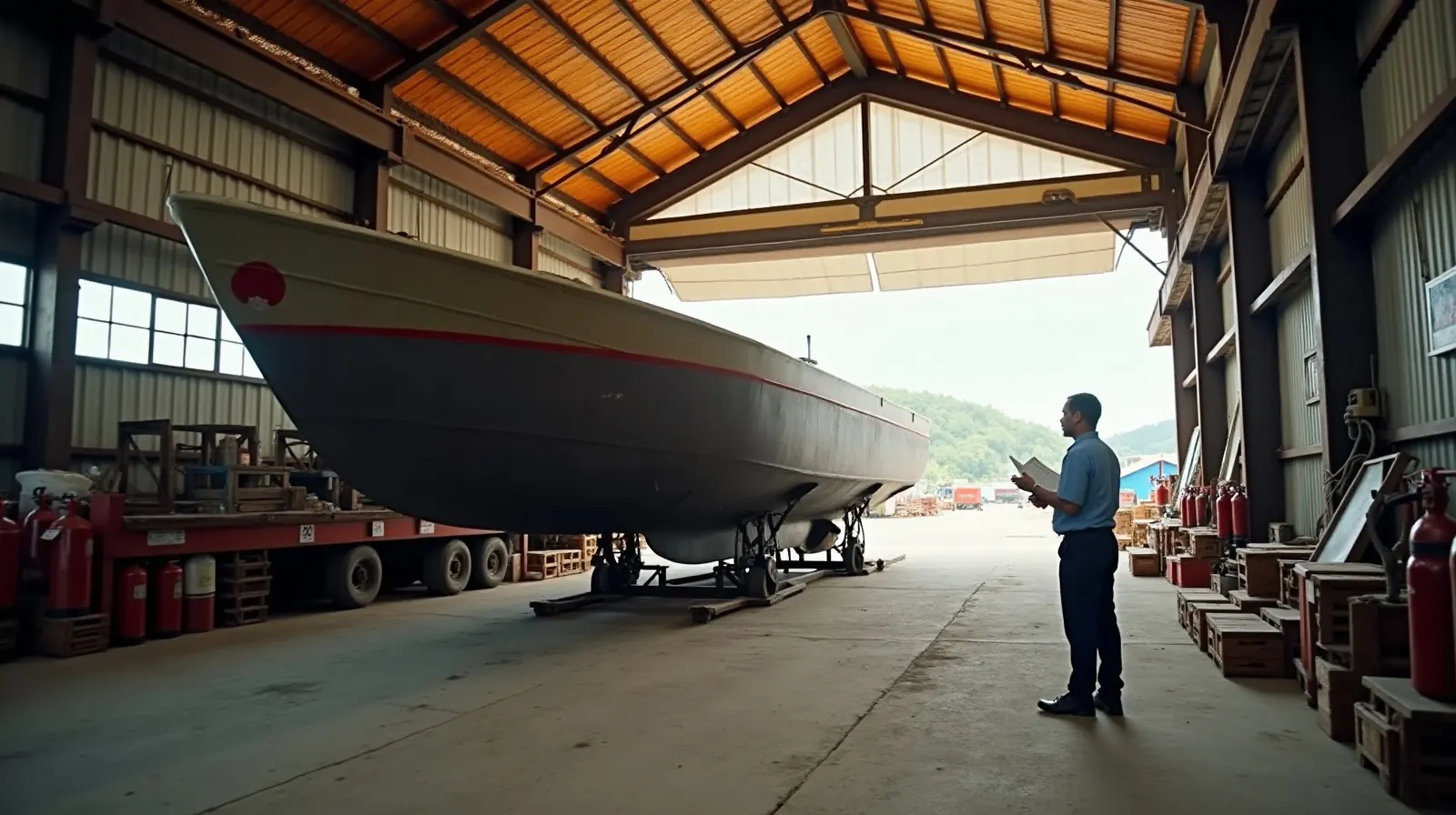
In short: A hull that doesn’t float yet is still a seven-figure asset sitting in a fire-prone workshop beside open water in a seismically active country. Builder’s risk insurance covers the vessel during construction, launch and trials; the owner’s job is to make sure a policy exists, that its insured value tracks the money actually invested, that launch and sea trials are explicitly covered, and that the policy pays the owner — not only the yard — if the worst happens.
Ask a room of owners mid-build who insures their hull and most will guess “the yard, probably”. Sometimes true, sometimes not, and the difference only becomes visible on the day a fire, flood or dropped crane load makes it urgent. Construction insurance is unglamorous, inexpensive relative to what it protects, and routinely neglected in Indonesian projects — including several that later reached our completion and takeover desk with uninsured losses baked into their history. Here is how to cover a hull from first timber to handover.
What builder’s risk insurance actually covers
Marine builder’s risk (construction all-risks) policies cover physical loss or damage to the vessel under construction: fire — by far the dominant workshop peril, given resins, solvents, hot work and timber dust in one building — plus theft, flood, storm, earthquake, dropped objects during lifts, and damage during the launch itself. Better policies extend to materials in transit and in storage off-site, which matters when your engines sit in a Surabaya warehouse for four months and your teak is seasoning at a second yard. Trials coverage extends protection through the vessel’s first movements afloat — the commissioning weeks we detail in our post-launch shakedown article and the formal proving runs covered in our piece on sea trial failures.
Standard exclusions to understand: defective workmanship itself (the cost of redoing bad work — that is what warranties and QA regimes are for), ordinary wear, and often consequential loss like schedule delay. Insurance replaces destroyed value; it does not buy back time.
Who insures, and who gets paid
Three arrangements appear in Indonesian practice. Established shipyards often carry an annual open policy covering all hulls on site — verify it, read the per-vessel limit, and confirm your project is declared. Smaller yards, including many traditional builders, carry nothing unless the contract forces the issue; there the owner buys the policy directly, through Indonesian insurers or regional marine markets in Singapore — and checks how third-party liability sits alongside hull cover, given the web of trades working on site. The third arrangement — assuming without checking — is the one to avoid.
Equally important is the loss-payee question. As you pay milestones, value transfers to you; if the yard’s policy pays only the yard after a total loss, you become an unsecured creditor hoping for a refund. The fix is standard: the owner named as co-insured and loss payee to the extent of instalments paid, dovetailing with the title-transfer and payment-security clauses we cover in our articles on escrowed milestones and shipyard contract law.
Setting the insured value — and keeping it honest
A construction policy insures a moving target: the hull is worth more every month. Declare an insured value that tracks cumulative investment — timber, plate, equipment delivered, labour performed — and update it at each stage gate. Underinsure and a partial loss pays out proportionally short; overinsure and you donate premium. On supervised builds we reconcile insured value against the payment schedule at every stage gate, a five-minute discipline that keeps the policy aligned with reality. Premium context: Indonesian builder’s risk typically prices at roughly 0.3 to 0.8 percent of insured value per year depending on yard fire protections, material and location — against a ten-year ownership cost picture we quantify in our cost-curve analysis, it is one of the smaller lines that buys the most sleep.
Claims: the file you hope never to open
If loss strikes, the claim stands on documentation assembled before the event: the declared value trail, progress photographs, delivery records for equipment aboard, and an independent record of build state. The same evidence disciplines we recommend for warranty claims and in our build diary article serve double duty here — an insurer’s surveyor reconstructing what existed on the night of a fire works from your file, or guesses against you. Our survey team documents build state for exactly this purpose during supervision visits.
Get the cover question answered this week
If you have a hull under construction anywhere in Indonesia and cannot state today who insures it, for how much, and who gets paid — that is a gap worth closing before the next hot-work permit. Request a free consultation, message us on WhatsApp at +62 811 3941 4563, or email [email protected], and we will review your contract’s insurance clause and connect you with marine underwriters who know Indonesian yards.
Frequently Asked Questions
How much does builder’s risk insurance cost in Indonesia?
Typically 0.3 to 0.8 percent of insured value per annum. A hull with USD 1,000,000 invested might carry USD 3,000 to 8,000 in yearly premium — driven by the yard’s fire precautions, construction material and whether launch and trials are included.
Does the yard’s insurance automatically protect my payments?
No. Unless you are named as co-insured or loss payee, the policy responds to the yard. Require proof of cover, a per-vessel limit adequate for your project, and loss-payee wording to the extent of instalments paid before releasing early milestones.
Is launch day covered?
Only if the policy says so — launch and trials are named extensions, not defaults. Given that the highest-energy moments of the whole build are the lift, the slide and the first sea runs, confirm this extension in writing before the airbags roll.
What about earthquake and tsunami risk at coastal yards?
Indonesian marine construction policies can include earthquake, volcanic action and tsunami; some quotes exclude them by default. Given where yards physically sit, we treat these perils as mandatory inclusions and flag any quotation that omits them.

Written by
